
Everyone wants a Bloomberg Terminal.
Nobody wants to pay Bloomberg Terminal prices.
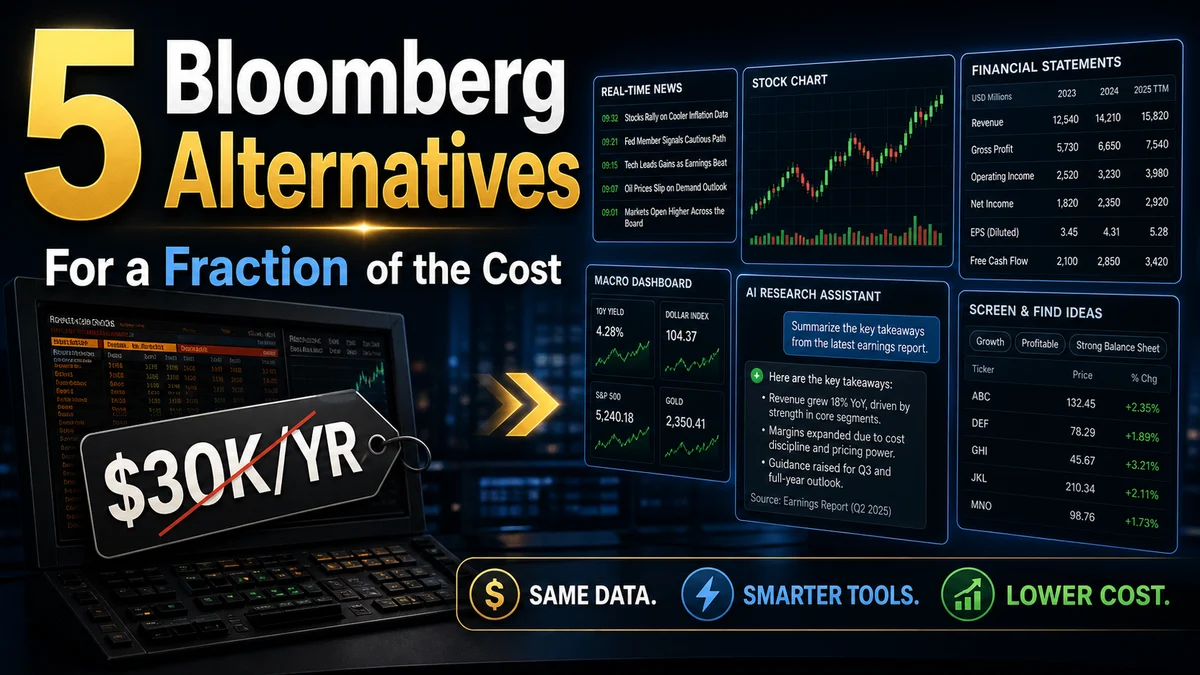
Depending on the source and subscription setup, Bloomberg Terminal pricing is often estimated around $24,000 to $32,000 per user per year, with many people simply rounding it to about $30,000 per year.
For large banks, hedge funds, and institutional trading desks, that can make sense.
For independent traders, newsletter writers, analysts, and serious retail investors, it is a massive expense.
The good news is that most people do not need a full Bloomberg Terminal.
They need pieces of what Bloomberg does well:
- Fast market-moving news
- Clean financial data
- Filings and transcripts
- Macro dashboards
- Screening tools
- Charting
- Analyst estimates
- AI-powered research
- A better workflow for finding ideas
You probably do not need to recreate Bloomberg perfectly.
You need the right stack of tools that helps you move faster, research better, and make smarter decisions without spending the price of a car every year.
Here are five Bloomberg Terminal alternatives traders and investors actually use.
1. Financial Juice
Best for: Real-time news, squawk, economic updates, and market-moving headlines
Financial Juice is one of the best tools for traders who need speed.
If you trade around news, economic data, Fed speakers, geopolitical headlines, earnings, or macro events, you need to know what is moving the market quickly.
That is where Financial Juice shines.
It offers real-time financial news, a 24/5 voice squawk, text headlines, market calendars, and coverage across equities, FX, rates, commodities, crypto, and macro.
This is not trying to be a full research terminal. It is much more focused than that.
Financial Juice is for traders who want to know:
- What just happened?
- Why is the market moving?
- Is this headline actually important?
- What economic data just came out?
- What are traders reacting to right now?
For active traders, that can be far more useful than a giant terminal full of features they may never touch.
Learn more about Financial Juice
2. Godel Terminal
Best for: Terminal-style workflows, filings, quotes, news, charts, and research
Godel Terminal is one of the more interesting Bloomberg-style alternatives.
It is a web-based financial terminal built for serious investors, analysts, and traders who want a more institutional workflow without paying Bloomberg-level pricing.
Godel includes features like real-time market quotes, Nasdaq-powered charting, SEC filings, financial statements, institutional ownership, analyst forecasts, and global news.
The standout feature is its command line interface.
Instead of clicking through endless menus, users can quickly pull up charts, filings, quotes, news, and other information through commands.
That matters because speed is one of the biggest reasons people love Bloomberg in the first place.
Godel is not Bloomberg. Nothing on this list is.
But if what you want is a fast, terminal-style platform with real-time data, filings, financials, and market information in one place, Godel is worth knowing.
Use code SAVEONTRADING for the current offer.
Learn more about Godel Terminal
3. Koyfin
Best for: Macro dashboards, charting, screening, portfolio tools, and multi-asset analysis
Koyfin is probably the closest thing to a true “Bloomberg-lite” for many investors.
It is clean, visual, and powerful.
Koyfin covers global equities, ETFs, mutual funds, fixed income, FX, crypto, macroeconomic data, analyst estimates, financials, watchlists, alerts, custom dashboards, and advanced charting.
The platform is especially strong for investors who care about macro context.
You can build dashboards around:
- Interest rates
- Currencies
- Commodities
- Global indices
- ETFs
- Economic data
- Sector trends
- Valuation metrics
- Company fundamentals
For advisors, Koyfin also has portfolio management and client-reporting features. For individual investors, the main value is the ability to see a lot of market data in one clean workspace.
If you are trying to replace the dashboard, charting, and market overview side of Bloomberg, Koyfin is one of the strongest options.
4. Stock Analysis
Best for: Fundamental stock research, financials, screeners, KPIs, downloads, and clean company data
Stock Analysis is my go-to choice for fast, clean stock research.
For most investors, it replaces a huge portion of what they would actually use Bloomberg for.
You can quickly research companies, view financial statements, analyze revenue, earnings, margins, cash flow, valuation, analyst forecasts, dividends, insider activity, ETF holdings, earnings calendars, and more.
The biggest advantage is the interface.
Stock Analysis is fast, clean, and easy to use. You do not have to fight the product to get the data you need.
That matters.
A lot of investors do not need the most complicated tool. They need a tool they will actually use every day.
Stock Analysis is especially useful for:
- Looking up company financials
- Comparing fundamentals
- Screening for stocks
- Checking earnings and analyst forecasts
- Downloading historical data
- Researching dividends
- Reviewing ETF holdings
- Building watchlists
- Moving quickly from idea to analysis
Stock Analysis Pro also unlocks deeper financial history, more screener functionality, downloads, watchlists, portfolios, ETF holdings, analyst filtering, dark mode, no ads, and more.
For the price, it is one of the best values in the investment research space.
Use code SAVEONTRADING for the current Stock Analysis offer.
Learn more about Stock Analysis
5. Fiscal.ai
Best for: AI-powered research, filings, earnings calls, KPIs, dashboards, and deep-dive analysis
Fiscal.ai, formerly FinChat, is one of the best AI-powered research tools for investors.
It helps investors move faster through filings, transcripts, earnings calls, financials, KPIs, models, and company research.
The key value is speed.
Instead of manually digging through filings and transcripts for every detail, Fiscal.ai helps surface the important information faster. You can ask questions, review cited answers, summarize earnings calls, analyze financials, and build dashboards.
It is especially useful for deep-dive fundamental investors who want to understand:
- What changed in the quarter?
- What did management say?
- What are the key KPIs?
- How are margins trending?
- What are the risks?
- What does the filing actually say?
- How does this company compare to peers?
AI research tools are not a replacement for thinking.
You still need to verify the source, understand the business, and make your own decisions.
But Fiscal.ai can dramatically speed up the research process, especially when you are covering a lot of companies.
Do These Tools Fully Replace Bloomberg?
Not exactly.
Bloomberg Terminal is still Bloomberg Terminal.
It has institutional messaging, fixed income tools, trading workflows, massive data coverage, proprietary datasets, and decades of built-out functionality.
If you work on a trading desk at a bank or run a large institutional book, Bloomberg may still be necessary.
But most traders and investors do not need all of that.
They need a practical stack that gives them:
- Real-time news
- Market dashboards
- Clean financial data
- Filings and transcripts
- Screening
- Charting
- AI-assisted research
- Faster workflows
For that, these tools can get you very far for a fraction of the cost.
The Best Bloomberg Alternative Stack
If I were building a Bloomberg-style research stack without paying Bloomberg prices, I would think about it like this:
For real-time news: Financial Juice
For terminal-style workflows: Godel Terminal
For macro dashboards and charts: Koyfin
For clean stock fundamentals: Stock Analysis
For AI-powered deep research: Fiscal.ai
You may not need all five.
A day trader may care most about Financial Juice and Godel.
A long-term investor may care most about Stock Analysis, Koyfin, and Fiscal.ai.
A macro-focused investor may use Koyfin heavily.
A fundamental analyst may spend most of their time in Stock Analysis and Fiscal.ai.
The point is to build the stack around your actual workflow, not around what sounds impressive.
Final Thoughts
Bloomberg Terminal is incredible.
It is also incredibly expensive.
At around $30,000 per year, it only makes sense if you truly need the full institutional product.
Most traders and investors can build a much cheaper research stack with tools like Financial Juice, Godel Terminal, Koyfin, Stock Analysis, and Fiscal.ai.
You will not get a perfect Bloomberg clone.
But you may get something better for your actual needs: a faster, cleaner, cheaper setup that helps you find ideas, research companies, track markets, and make better decisions.
And for most people, that is the real goal.